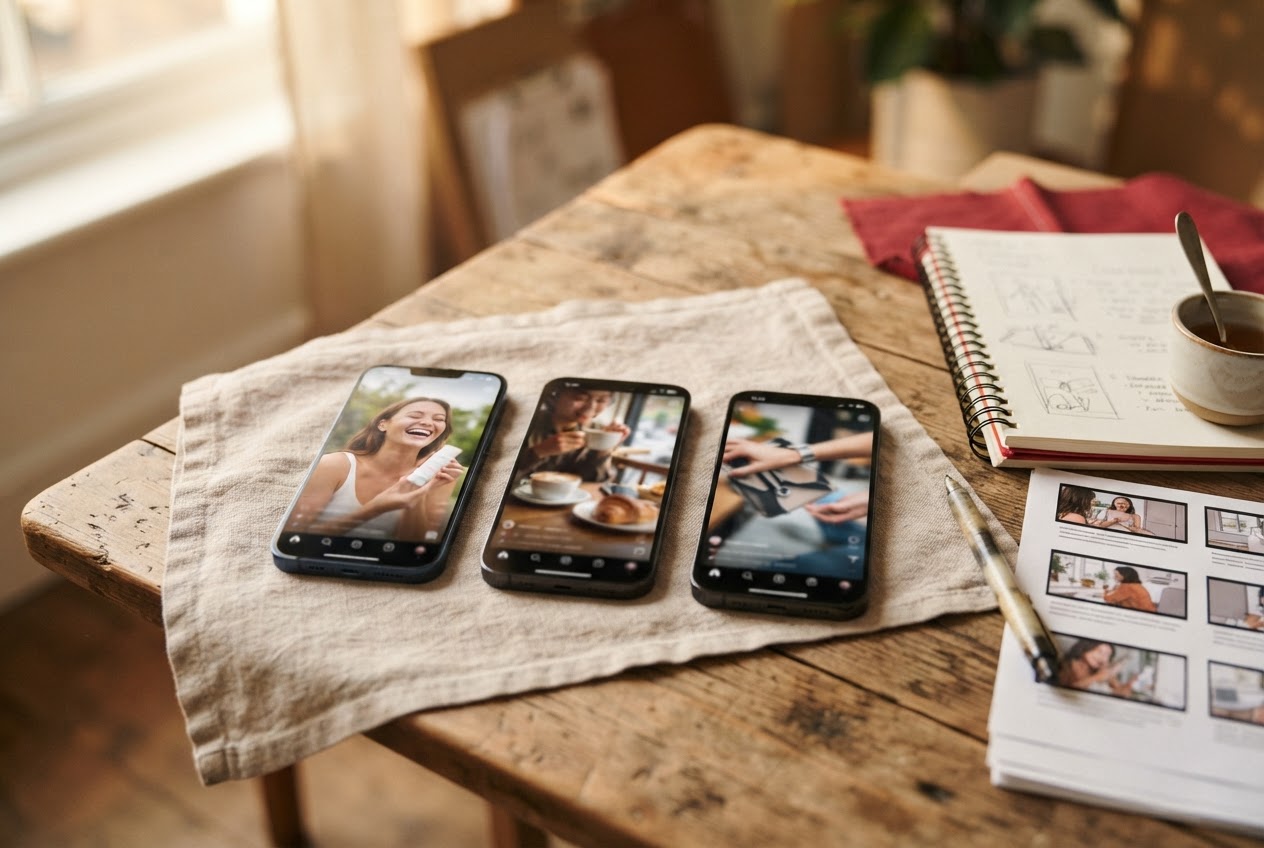
Ad creative testing is the process of putting different ad concepts, hooks and formats in front of real audiences, measuring which ones hold attention and drive sales, and feeding the winners back into your campaigns. On Meta and TikTok it is now the main lever you control, because both platforms increasingly decide who sees your ads for you. The brands that win are the ones that test creative on a steady, structured cadence rather than guessing.
This guide sets out a practical framework: what to test, in what order, how to structure tests, which metrics to read and how often to refresh.
Why Is Creative the Main Lever on Meta and TikTok Now?
A few years ago, a lot of paid social performance came from clever audience targeting: stacked interests, lookalikes and tight exclusions. That has changed.
Meta's Advantage+ audience is designed to create the broadest possible audience to search within, keeping only hard constraints such as location, minimum age and exclusions. Meta's own engineering team has explained that its Andromeda ad retrieval system is built to handle a fast-growing volume of ads, and that increased ad diversity can improve people's experience with ads and drive better advertiser outcomes.
TikTok says much the same. Its creative best practices for performance ads recommend running 3 to 5 different creatives per ad group, and note that creatives with big differences work better, especially during testing.
In practice, your creative does much of the targeting. A video about the school run finds parents. A video about technical specs finds enthusiasts. If every ad says the same thing, the algorithm has fewer routes to new customers.
What Should You Test First in Your Ad Creative?
Test in order of impact, from the biggest swings to the smallest tweaks.
1. Concepts and angles
The concept is the core idea: the problem you solve, the person you speak to and the reason to believe. Examples include a pain-point angle, a social proof angle, a comparison against the old way of doing things, or a founder story. Different concepts reach different pockets of your audience, so this is where the largest gains usually sit.
2. Hooks
Once a concept shows promise, test the opening. The hook is the first line, image or movement that stops the scroll. TikTok advises putting the hook first and introducing your content proposition within the first 3 seconds. Keep the body of the ad the same and swap only the opening to see which hook earns attention.
3. Formats
Test the same concept across static images, short vertical video, carousels and longer explainer video. Some products sell in a single image. Others need a demonstration. For TikTok and Reels, shoot vertically at 9:16 and keep key content inside the safe zone.
4. UGC vs studio
UGC ads, made by creators or customers on a phone, often feel native to the feed and build trust quickly. Polished studio work carries more brand authority and suits premium products. Test both against the same concept, and consider hybrids such as studio-shot product footage with a creator voiceover.
5. Offers
Free delivery, bundles or a first-order discount can change performance sharply, but they also change your margin. Judge offers on profit, not just conversion rate.
How Do You Structure Facebook Ad Creative Testing?
Good facebook ad creative testing is about control. The aim is to learn something you can act on, not just to see which ad got lucky this week.
- Separate testing from scaling: Run new creative in a dedicated testing campaign or ad set, then move proven winners into your main scaling campaigns. This stops untested ads diluting the budget behind your best performers.
- Change one thing at a time: If you change the hook, format and offer together, you will not know which change made the difference. Test concepts against concepts, then hooks within a winning concept.
- Group variations sensibly: Following TikTok's guidance, 3 to 5 genuinely different creatives per ad group is a sensible starting point on both platforms. Too many and spend spreads so thinly that nothing gets enough data.
- Budget for a result, not a click: Set the testing budget so each creative has a realistic chance of reaching several conversions. If your cost per acquisition is high, you may need to judge early tests on leading metrics like hook rate and CTR, then confirm on CPA.
- Give it enough time: Avoid judging after a few hours. Let tests run long enough to cover different days of the week, and avoid editing ads mid-test, which can reset learning.
On statistical sense: resist small numbers. Two sales against one is not a winner. Look for clear, consistent gaps across a meaningful number of impressions and conversions. If the result is close, call it a draw and run a bigger test.
Which Ad Creative Testing Metrics Actually Matter?
Each metric tells you about a different stage of the ad. Read them in sequence and you can diagnose exactly where an ad is failing.
- Hook rate (thumb-stop rate): Usually calculated as 3-second video views divided by impressions. It tells you whether the opening stops the scroll. A low hook rate points to the first frame, first line or thumbnail.
- Hold rate: The share of people who keep watching, often measured as ThruPlays or 15-second views divided by 3-second views. A strong hook with weak hold means the ad grabs attention and then loses it, so look at pacing and the middle of the script.
- Click-through rate (CTR): Shows whether the ad creates enough interest to act. Good hold with weak CTR often means the call to action or offer is unclear.
- CPA and ROAS: Cost per acquisition and return on ad spend are the commercial verdict. An ad with a lower CTR but better CPA is the better ad. If CTR is strong but CPA is poor, the problem may be the landing page or a mismatch between the ad's promise and what people find after the click.
Check your tracking first. If your pixel, Conversions API or TikTok Events API are not recording conversions properly, your creative decisions rest on bad data.
How Do You Spot Creative Fatigue?
Creative fatigue happens when the same audience sees an ad too often and stops responding. Every winning ad fatigues eventually. The question is how quickly you notice.
Common signs include:
- Frequency climbing while CTR falls
- Hook rate dropping on an ad that used to stop the scroll
- CPA rising steadily over several days with no change to the account, the site or the season
- Comments repeating, or people saying they keep seeing the ad
TikTok recommends refreshing creatives when performance shows a consistently declining trend, and adding new creatives to an existing ad group to extend its life rather than starting again. The same logic works on Meta. Keep a pipeline of new variations ready so fatigue becomes a scheduled swap, not an emergency.
What Does a Weekly Ad Creative Testing Cadence Look Like?
A simple weekly rhythm keeps testing consistent without overwhelming a small team.
- Monday: review. Pull hook rate, hold rate, CTR, CPA and ROAS for live tests and scaling ads. Flag fatigue and tag winners and losers.
- Tuesday: decide. Move clear winners into scaling campaigns. Pause clear losers. Note what the winners have in common, whether that is the angle, the opening line, the creator or the format.
- Wednesday: brief. Write briefs for the next round, building on what won. If a hook worked, brief new variations of it. If a concept failed, try a new one rather than polishing it.
- Thursday and Friday: produce and launch. Edit, check specs and launch the next batch so it gathers data over the weekend.
Keep a simple testing log of what you tested and what happened. After a few months, it tells you what your audience actually responds to.
How Should You Brief Creators for UGC Ads and TikTok Ad Creative?
Weak briefs produce weak UGC ads. A good brief gives creators structure without scripting the life out of them.
- The single message: One clear idea per video. If you want to test two angles, commission two videos.
- Three to five hook options: Ask creators to film several openings so you can test hooks without reshooting the whole ad.
- Must-say and must-not-say points: Key product claims, compliance limits and anything that would be misleading.
- Format and specs: Vertical 9:16, sound on, captions, and key content kept clear of the platform interface.
- Reference examples: Show the tone and pacing you want, but let creators speak in their own words. Native-feeling tiktok ad creative usually beats a read-out script.
- Usage rights: Agree how long and where you can run the content as paid ads, including whether you can run it from the creator's own handle.
For more polished meta ads creative, the same principles apply. Brief the concept and the hook first, and treat the production values as a variable you can test, not a given.
When Should You Bring in a Creative Agency?
Many brands can run a basic testing programme in-house. It becomes harder when the bottleneck is volume, skill or perspective.
It may be time to bring in help if:
- You cannot produce enough new creative to keep ahead of fatigue
- Your ads all look and sound the same, and new tests rarely beat old winners
- Your media buying and your creative are run by different people who rarely talk
- You are spending meaningful budget but cannot say which concepts are working and why
The strongest set-up connects strategy, production and media buying. Our paid social team runs the testing structure and reads the data, while our campaign and ad creative service develops concepts and hooks from what the numbers show. Where you need finished assets at volume, our video production and content creation teams produce studio and UGC-style content built for testing.
Frequently Asked Questions
1. How many creatives should I test at once?
A: Start with 3 to 5 genuinely different creatives per ad group. Many more spreads budget so thinly that no single ad gets enough data to judge.
2. What is a good hook rate?
A: It depends on your sector, format and placement, so the most useful benchmark is your own account. Compare new ads against your current best performers and look for openings that consistently beat them.
3. How often should I refresh my ads?
A: Refresh when the data tells you to, not on a fixed date. Rising frequency, falling CTR and a steadily climbing CPA are the signals. Higher budgets and smaller audiences usually mean faster fatigue, so plan new creative into every week.
4. Do UGC ads always outperform studio creative?
A: No. UGC ads often feel more native on TikTok and Reels, but studio creative can win for premium products or brand-led campaigns. Test both against the same concept and let the results decide.
Ad creative testing is not a one-off project. It is a weekly habit that compounds, and on Meta and TikTok it is the clearest route to lower costs and more scale. Kinsman & Co is a London-based Google Partner agency working with ecommerce, hospitality, B2B and lead-generation brands. If you want a structured creative testing programme that links ideas, production and media buying, book a call with our team and we will show you where to start.